Showing posts with label Generator Operation. Show all posts

Thursday, July 8, 2010

STORE THE GENERATOR PROPERLY

The majority of the generator problems occur after the generator is removed from prolonged storage. Gasoline has a very short shelf life. The fuel in the carburetor bowl is vented to the atmosphere. Evaporation of the fuel occurs quicker and will leave the heavier additives and water to plug and corrode the carburetor passages.

If the generator is to be stored for more than 2 months:

Drain the fuel from the carburetor float bowl.

Drain the fuel from the sediment cup.

Add the correct proportion of fuel conditioner to the tank and top it off.

In addition, it is also recommended:

Add a tablespoon of oil through the spark plug hole. Lubricating the valves and piston rings will help prevent corrosion during extended storage periods.

Change the engine oil. Engine oil oxidizes and breaks down like gasoline. Fresh engine oil will ensure the oil will provide proper lubrication when the engine is started after the storage period.

14.jpg (26555 bytes)

STORAGE
Store the generator properly.
Refer to the appropriate owner’s manual.

TURN OFF THE FUEL VALVE (if equipped)

Turn the fuel valve OFF when transporting or storing the generator. When the generator is being transported, the carburetor inlet needle may unseat allowing fuel to enter the engine crankcase. Gasoline will dilute the engine oil reducing the lubrication properties and cause severe engine damage.
13.jpg (21920 bytes)
Turn The Fuel Valve OFF
Turn OFF the fuel valve when transporting the generator.
Turn OFF the fuel valve when the generator is not in use.

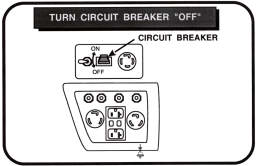
TURN THE CIRCUIT BREAKER OFF

SAFETY PRECAUTION!

Turn the circuit breaker OFF when starting the generator.

The generator starts producing power immediately after the engine starts. Start the generator and wait 15 seconds to let it come up to speed and generate the proper voltage, then turn the loads on. If there is a heavy load connected to the generator, it may be strong enough to make the engine hard to start.

If the engine does not start, a heavy load may not allow the engine to reach operating speed. Continuous operation of the generator below normal operating speed may damage the load or the generator.

The circuit breaker should be switched OFF before stopping the engine. The generator will produce power until the engine comes to a complete stop. AVR generators will try to produce steady output as the generator winds down. This may overload the AVR circuits, which could damage the AVR.

12.jpg (16677 bytes)

STOPPING THE GENERATOR
Turn OFF the circuit breaker before starting the engine.
Turn OFF the circuit breaker before stopping the engine.

SYSTEM GROUND

The power tool has a ground wire that connects the tool body to the generator receptacle.

The generator ground terminal is connected to: the frame of the generator, the metal non-current carrying parts of the generator, and the ground terminals of each receptacle.

Before using the ground terminal, consult a qualified electrician, electrical inspector or local agency having jurisdiction for local codes or ordinances that apply.

11.jpg (35265 bytes)

System Ground
Generator frame acts as system ground.
Local codes or agencies may require further generator grounding.

Tuesday, July 6, 2010

NEUTRAL BONDING REQUIREMENTS

Bonding the neutral wire to ground is required on some construction sites. Industrial Generators provide neutral bonding.

Some models are neutral bonded which allows the industrial generator to pass OSHA job site inspections.

10.jpg (35661 bytes)

Neutral BondRequired on certain job sites.Neutral conductors bonded to ground.Standard on some Honda & Pramac ES models.

GFCI TESTING

Under normal operations, the GFCI should be tested monthly. There is a test card located on the control panel to record the date of each test. If the generator is stored outdoors, unprotected from the weather, test the GFCI receptacle before each use.

Testing - You must test it to make sure it works!

Press the TEST button. The RESET button should extend with a click.

Press the RESET button. The RESET button should be flush with the TEST button.

If either of these tests fail on a Honda generator, contact an authorized Honda generator servicing dealer.

8.jpg (22584 bytes)

GFCI Testing
Test monthly normally.


Test before each use if stored outdoors.
9.jpg (17104 bytes)
Honda and Other High Quality Makes
GFCI is standard on some models.
GFCI will protect 120V duplex receptacles.
20, 30 and 50 Amp 120V receptacle
Isolated ground system – no neutral bond with the frame.

GFCI OPERATION

Electric current (amperage) flow is the same in the wires going to and coming from the load. When a ground fault occurs, electric current now has another path and will take this path instead of returning to the source.

Current traveling in wires create magnetic fields around those wires. If the current is the same coming and going, the magnetic fields cancel one another. When there is a ground fault, the returning current has two paths. The returning current through the GFCI is less than the going, there is now a magnetic field difference through the transformer and the control unit will automatically open the circuit.

7.jpg (32508 bytes)

GFCI Operation
Detects ground faults in tools or appliances.
GFCI opens the power circuit.
TEST button creates ground fault situation for testing GFCI receptacle.

GFCI APPLICATIONS

In certain applications, Honda industrial generators fall under OSHA regulations. One such regulation is that 120V, 15 and 20 ampere receptacles be protected by Ground Fault Circuit Interrupters (GFCI) automatically open the power circuit in the event there is a current leakage in the tool or appliance plugged into the GFCI receptacle. The GFCI will open the circuit protecting the operator from ground faults. Examples of ground fault current is the current which would flow through a person who is using an appliance with faulty insulation and, at the same time, is in contact with an electrical ground such as a plumbing fixture, wet floor, or earth.

The ground fault circuit interrupter receptacle will not protect against short circuits or overloads. The circuit breaker or circuit protector in the control panel, which supplies power to the circuit, provides that protection.

6.jpg (12116 bytes)

GFCIGFCI protection is required for certain applications.Must protect all 15 and 20 ampere 120V receptacles.

Monday, July 5, 2010

AUTO-THROTTLE or IDLE CONTROL

The auto-throttle system automatically reduces engine speed when all loads are turned off or disconnected. When appliances are turned on or reconnected, the engine returns to the rated speed.

The auto-throttle system will not respond to electrical loads of less than 1 ampere.

The system is not effective for use with appliances that require only momentary power. Leave the auto-throttle OFF if an appliance cycles on and off frequently.

To avoid extended warm-up periods, keep the switch OFF until the engine reaches operating temperature.

Appliances with large start-up power demands may cause the engine to be overloaded and keep it from reaching normal operating RPM. Turn the auto-throttle to the OFF position and connect the appliance to the generator. If the engine is still overloaded and cannot reach normal operating rpm, check that the appliance does not exceed the rated load capacity of the generator.

If the generator is equipped with a pilot light or volt meter and the auto-throttle is ON but no load is connected:

The pilot light will be dimmer.

The voltmeter will display less than the normal output voltage (120V or 240V).

5.jpg (16013 bytes)

Auto-Throttle OR Idle Control
Lower fuel consumption
Reduced noise

BALANCE THE LOAD

The generator has two separate main power producing circuits. These two circuits supply equal power to the receptacles shown when the voltage selector switch is in the "120/240V" position. When two or more receptacles are used; prevent overloading by dividing the loads between the two power circuits.

Example: (ES7500 rated current draw is 50A)

Receptacle 2 has a 15A load connected to it. Receptacle 3 has a 15A load connected to it. Both receptacles are powered by the main power circuit 1. The equation tells us that the total power draw on Circuit 1 is 30A (greater than 25A). This is a substantial overload to this circuit. To eliminate the excess power draw on circuit 1, the load from receptacle "3" should be switched to receptacle "1". Now circuit 1 is powering a 15A load (less than 25A) and circuit 2 is powering a 15A load (less than 25A).

When the voltage selector is in the "120V ONLY" position, do not exceed the rated capacity of any one receptacle. For all receptacles used, do not exceed the rated load capacity of the generator.

4.jpg (24526 bytes)

Balance The Load
"120/240V" position.
Connect loads to balance the two main windings.

PROPER OPERATION OF YOUR PORTABLE GENERATOR


ALWAYS CHECK THE FUEL LEVEL BEFORE STARTING YOUR GENERATOR

ALWAYS THINK SAFETY. PROTECT YOURSELF AND EVERYONE AROUND YOU. SAFETY FIRST!

Here are some simple rules to help you keep your portable generator running smoothly and for a long time.

Most portable generator engines are engineered, designed and certified to run on unleaded fuel. Use unleaded gasoline with a pump octane rating of 86 or higher. Unleaded fuel will reduce deposit build-up on valves, spark arrestor, muffler and spark plug.

Never use stale or contaminated gasoline or oil/gasoline mixture. Avoid getting dirt or water in the fuel tank.

Gasoline blended with alcohol or ether is referred to as "oxygenated" fuel. Before using oxygenated fuel, try to confirm the fuel’s contents (refer to the owner’s manual). Some states (provinces of Canada) require the information to be posted on the pump. If you notice any undesirable operating symptoms, try another service station or switch to another brand of gasoline.

Refuel when the engine is off. Gasoline is extremely flammable and is explosive under certain conditions. Refuel in a well-ventilated area with the engine stopped. Do not over fill. Make sure that any spilled fuel has been wiped off before starting the generator.

The fuel tank cap vents to the atmosphere. Don’t store the generator below the deck of a boat. Gasoline fumes can collect and ignite. Store the generator in a well-ventilated area.

Do not smoke or allow sparks in the area when refueling.

Never refuel while the engine/generator is running. Refuel the generator with the engine stopped and the engine cool.

Wipe up spilled fuel before starting the generator. The engine produces enough heat at the exhaust system, and the generator produces sufficient static electricity, to ignite the fuel vapors.

PRE-OPERATION CHECKS


Voltage Selector Switch
Allows simultaneous use of 120V and 120/240V receptacles.
"120 ONLY" position: maximum power from locking plug.
"120/240V ONLY" position: simultaneous use.